- Free Online Tool
Code Cracker vs Crossword vs Codeword – What's the Difference?
Many puzzle lovers use the terms code cracker, crossword, and codeword interchangeably but they are not the same thing. Each puzzle type has its own rules, its own solving method, and its own history. Picking up the wrong tool or using the wrong strategy wastes time and leads to frustration. Try a grid yourself with our free Code Cracker solver.
- At a Glance
Quick Answer – Code Cracker vs
Crossword vsCodeword at a Glance
you the essential differences in one place.
| Feature | Code Cracker | Crossword | Codeword |
|---|---|---|---|
| Country of origin | New Zealand | United States | United Kingdom |
| Created by | Simon Shuker (1990s) | Arthur Wynne (1913) | Simon Shuker (adapted for UK) |
| How clues work | No clues — numbers replace letters | Written clues for every answer | No clues — numbers replace letters |
| Grid type | Numbered substitution grid | Black-and-white word grid | Numbered substitution grid |
| Starting information | 3 pre-given letters | Full clue list | 3 pre-given letters |
| Solving method | Logic + deduction | Vocabulary + knowledge | Logic + deduction |
| Proper nouns allowed | Never | Sometimes | Never |
| Same as each other? | Same as Codeword | Different puzzle entirely | Same as Code Cracker |
| Main region | New Zealand, Australia | Global | United Kingdom |
| Published in | NZ Herald, Dominion Post | Most newspapers globally | Daily Mail, UK puzzle magazines |
- Puzzle 01
What Is a Code Cracker Puzzle?
A code cracker is a word puzzle built on a substitution cipher. Every letter of the alphabet has been replaced by a number from 1 to 26. One number always maps to one letter and that rule never changes anywhere in the grid.
There are no written clues of any kind. You begin with a small number of pre-revealed letter-number pairs usually three and use those as your starting point. From there, the entire puzzle is solved through logical deduction: you figure out what number maps to what letter by examining word patterns, letter frequencies, and the relationships between crossing words. Unlike crosswords there are no clues, which is why how to solve a Code Cracker starts with pattern spotting.
Key Rules of Code Cracker Puzzles
- Every letter from A to Z appears at least once in the completed grid.
- No proper nouns all answers come from the standard English dictionary.
- The solver starts with exactly 3 pre-given letter-number pairs.
- One number always equals one letter throughout the entire grid no exceptions.
- The grid is typically 15×15, the same physical size as a standard crossword.
- No written clues of any kind are provided.
Who Invented Code Cracker?
Simon Shuker, a Wellington-based New Zealand puzzle maker, created the Code Cracker puzzle in the mid-1990s. He handcrafts every puzzle individually none of his puzzles are computer-generated. This manual approach keeps the difficulty balanced and ensures every puzzle has a satisfying, logical solving path from the first decoded letter to the last.
Code Cracker now runs daily in all major New Zealand newspapers including the NZ Herald, Dominion Post, The Press, and Otago Daily Times. Simon Shuker has also published 21 book volumes of Code Cracker puzzles as of 2024.
- Puzzle 02
What Is a Standard Crossword Puzzle?
A standard crossword is a grid puzzle where solvers fill in words based on written clues. The grid consists of white squares (where letters go) and black squares (which act as dividers). Answers interlock horizontally (Across) and vertically (Down).
Unlike a code cracker, a crossword solver needs no knowledge of substitution ciphers or letter frequencies. The solving skill is primarily vocabulary, general knowledge, and for cryptic crosswords an understanding of puzzle-setter wordplay conventions.
The whole method rests on letter frequency in Code Cracker puzzles rather than general knowledge.
Types of Crossword Puzzles
Quick Crossword
Straightforward definition clues
General vocabulary
Daily newspapers globally
Cryptic Crossword
Clues have double meanings, anagrams, hidden words
Wordplay + lateral thinking
UK, Australia, NZ
American-Style
Wide-open grid, theme-based answers
Pop culture + trivia
USA (NYT, WSJ)
Themed Crossword
All answers relate to one topic
Vocabulary + topic knowledge
Magazine puzzles
Mini Crossword
5×5 or smaller grid
Quick vocabulary
Online (NYT Mini)
Diagramless
No black squares given — solver places them
Advanced solving skill
Niche puzzle books
Key Rules of Code Cracker Puzzles
Every answer corresponds to a numbered Across or Down clue.
- All answers interlock shared letters must work in both directions.
- Proper nouns are allowed and common in themed crosswords.
- Grid size varies typically 15×15 for standard, 5×5 for mini.
- Black squares follow a rotational symmetry pattern in most professional grids.
- No number-to-letter substitution is used at any point.
Every letter from A to Z appears at least once in the completed grid.
- No proper nouns all answers come from the standard English dictionary.
- The solver starts with exactly 3 pre-given letter-number pairs.
- One number always equals one letter throughout the entire grid no exceptions.
- The grid is typically 15×15, the same physical size as a standard crossword.
- No written clues of any kind are provided.
History of the Crossword Puzzle
Simon Shuker, a Wellington-based New Zealand puzzle maker, created the Code Cracker puzzle in the mid-1990s. He handcrafts every puzzle individually none of his puzzles are computer-generated. This manual approach keeps the difficulty balanced and ensures every puzzle has a satisfying, logical solving path from the first decoded letter to the last.
Code Cracker now runs daily in all major New Zealand newspapers including the NZ Herald, Dominion Post, The Press, and Otago Daily Times. Simon Shuker has also published 21 book volumes of Code Cracker puzzles as of 2024.
The most popular version in New Zealand is covered in our Simon Shuker Code Cracker solver guide.
- Puzzle 03
What Is a Codeword Puzzle?
A code cracker is a word puzzle built on a substitution cipher. Every letter of the alphabet has been replaced by a number from 1 to 26. One number always maps to one letter and that rule never changes anywhere in the grid.
There are no written clues of any kind. You begin with a small number of pre-revealed letter-number pairs usually three and use those as your starting point. From there, the entire puzzle is solved through logical deduction: you figure out what number maps to what letter by examining word patterns, letter frequencies, and the relationships between crossing words.
Key Rules of Codeword Puzzles
- Identical to Code Cracker in every mechanical respect.
- Every letter A to Z appears at least once in the completed grid.
- No proper nouns all answers from the standard English dictionary.
- 3 pre-given letter-number pairs provided as starting information.
- One number always equals one letter throughout no exceptions.
- No written clues provided at any point.
- Same Puzzle?
Code Cracker vs Codeword – Are
They Really the Same?
Yes. A code cracker and a codeword are the same puzzle. The mechanics, rules, grid format, starting conditions, and solving strategy are completely identical. The only difference is regional naming. Both puzzle types sharpen the mind, as explained in Code Cracker puzzle brain benefits.
| Aspect | Code Cracker | Codeword | |
|---|---|---|---|
| Puzzle mechanic | Numbers 1–26 replace letters | = | Numbers 1–26 replace letters |
| Grid format | 15×15 substitution crossword | = | 15×15 substitution crossword |
| Clues provided | None | = | None |
| Starting letters | 3 pre-revealed pairs | = | 3 pre-revealed pairs |
| Proper nouns | Not allowed | = | Not allowed |
| Every letter appears | Yes — A to Z guaranteed | = | Yes — A to Z guaranteed |
| Creator | Simon Shuker | = | Simon Shuker (same person) |
| Primary region | New Zealand, Australia | ≠ | United Kingdom |
| Published in | NZ Herald, Dominion Post | ≠ | Daily Mail, UK puzzle magazines |
| Solving tools | Code cracker solver | = | Codeword solver (same tool) |
A code cracker solver tool works for codeword puzzles and vice versa. The same wildcard pattern-matching system (*, +, -) applies equally to both. If you can solve one, you can solve the other — just under a different name.
- Key Differences
Code Cracker vs Crossword – The Key
Differences
While a code cracker and a crossword share the same physical grid dimensions and the same goal of filling every white square with a letter, they are fundamentally different puzzles requiring completely different solving skills. You’ll find digital versions of both in our Code Cracker solver app comparison.
| Difference | Code Cracker | Standard Crossword |
|---|---|---|
| Information given | 3 letter-number pairs | Full clue list (Across and Down) |
| Clue type | No clues at all | Definition or cryptic wordplay |
| Primary skill | Logic and deduction | Vocabulary and general knowledge |
| Letter frequency use | Essential — E is most common | Not relevant |
| Proper nouns | Never used | Frequently used |
| Can be solved by a non-native speaker? | Yes — logic-based | Harder — knowledge-based |
| Grid fill completion | Must decode all 26 letters | Each clue solved independently |
| Typical solving time | 20–40 minutes | 15–60 minutes depending on type |
| Right answer confirmation | Cross-checking numbers | Crossing letters from other answers |
| Solver tool type needed | Pattern matcher (letter + wildcards) | Clue-based answer lookup |
When to Use a Code Cracker Solver vs a Crossword Solver
The type of solver tool you need depends entirely on which puzzle you are working on.
| You have a numbered grid with no clues | → | Code cracker solver — enter known letters and wildcards |
| You have a written clue like "capital of France (5)" | → | Crossword clue solver — enter the clue text |
| You know some letters in a crossword answer | → | Code cracker solver — works for pattern matching |
| You need an anagram solved | → | Anagram solver — separate tool entirely |
| You have a UK codeword puzzle | → | Code cracker solver — identical mechanic |
| You have a cryptic crossword clue | → | Cryptic crossword solver — specialised tool |
- Difficulty
Codeword vs Crossword – Which Is Harder?
The difficulty comparison between a codeword and a crossword depends entirely on the solver’s strengths. They test different skills, so a person who finds crosswords easy may find codewords (code crackers) challenging and vice versa.
| Skill Type | Favours Crossword Solvers | Favours Codeword / Code Cracker Solvers |
|---|---|---|
| Strong general knowledge | Yes — trivia helps with clues | Not relevant |
| Strong vocabulary | Yes — useful for understanding clues | Helps but not essential |
| Logical deduction | Somewhat | Yes — core skill |
| Pattern recognition | Somewhat | Yes — essential |
| Letter frequency knowledge | Not needed | Yes — E, T, A frequency is key |
| Tolerance for ambiguity | High — cryptic clues are vague | Low — code crackers have one correct answer |
| Foreign language speakers | Disadvantaged by clue language | More accessible — logic-based |
Most puzzle magazines rate code crackers as medium-to-hard difficulty — harder than a quick crossword but generally easier than a cryptic crossword. The initial stages of a code cracker (the first 5–6 decoded letters) tend to be the hardest part. After that, the cascade of revealed letters makes the final stages much easier.
- Don't Mix Them Up
Other Word Puzzles Often Confused With Code Crackers
Several other puzzle types share characteristics with code crackers, codewords, or crosswords and are worth distinguishing.
Cryptic Crossword
- A crossword variant not a substitution cipher.
- Each clue contains two parts: a definition and a wordplay element (anagram, hidden word, reversal, etc.).
- Solving a cryptic crossword requires understanding puzzle-setter conventions not logic in the code cracker sense.
- Popular in the UK, Australia, and New Zealand.
- Considered the hardest mainstream crossword form.
Codebreaker Puzzle
- Another regional name for the same code cracker / codeword puzzle.
- Used primarily in UK puzzle magazines (Puzzler, Take a Break, etc.).
- Mechanically identical numbers replace letters, no clues, 3 pre-given pairs.
- Sometimes used as a brand name rather than a generic puzzle type.
Acrostic Puzzle
- Letters in each answer spell out a hidden message or author quote when read in order.
- Uses written clues like a crossword not a substitution cipher.
- Popular in American puzzle magazines.
- Requires both vocabulary knowledge and the ability to spot the hidden acrostic pattern.
Word Search
- A grid of random-looking letters hiding specific words placed horizontally, vertically, or diagonally.
- No substitution cipher letters are plain text.
- No deduction required purely visual scanning.
- Considered the easiest mainstream word puzzle format.
- Not related to code crackers or crosswords in terms of solving method.
- Around the World
Regional Names for Code Cracker and Codeword Puzzles Around the World
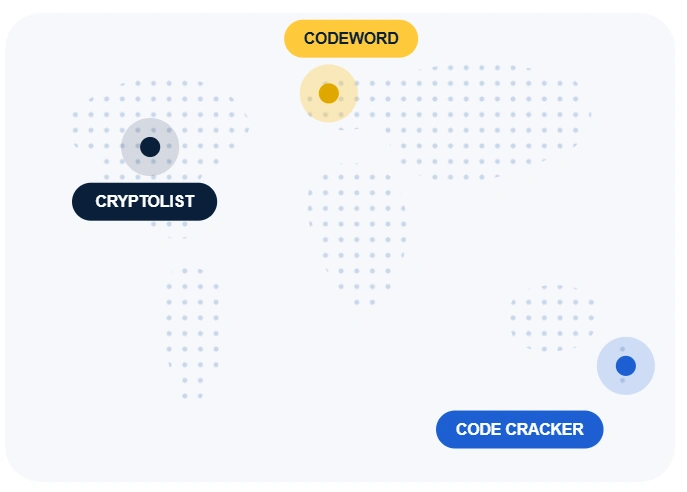
The same substitution cipher puzzle is published under different names depending on where you live. This table covers all major regional variants.
| Puzzle Name | Region | Published In | Creator / Origin |
|---|---|---|---|
| Code Cracker | New Zealand, Australia | NZ Herald, Dominion Post, The Press, Otago Daily Times | Simon Shuker, Wellington NZ |
| Codeword | United Kingdom | Daily Mail, UK puzzle magazines | Simon Shuker (adapted for UK) |
| Codebreaker | United Kingdom | Puzzler magazine, Take a Break | Various UK publishers |
| Coded Crossword | International | Various online platforms | Generic international term |
| Code-Cracker | Brand name (NZ) | Simon Shuker book series (Vol 1–21) | Simon Shuker |
| Cryptolist | United States | Niche US puzzle publications | American variant — list format, not grid |
- Find Your Fit
Which Puzzle Is Right for You – Code
Cracker, Crossword, or Codeword?
Choosing the right puzzle type depends on your strengths, your patience level, and what kind of mental workout you are after.
| If you prefer… | Best puzzle for you | Why |
|---|---|---|
| Pure logical deduction → | Code Cracker / Codeword | No clues — entirely logic-driven |
| Testing your general knowledge → | Standard Crossword | Clues require trivia and vocabulary |
| A single definitive answer → | Code Cracker / Codeword | Only one correct letter mapping exists |
| Wordplay and lateral thinking → | Cryptic Crossword | Clues are designed to mislead and reward clever thinking |
| A shorter solving session → | Mini Crossword or Code Cracker | Mini crosswords are fastest; code crackers have natural stopping points |
| Playing on your phone → | Any | Browser tools and apps exist for all; code cracker solvers work on mobile browsers |
| A daily habit → | Code Cracker (NZ Herald) or Codeword (Daily Mail) | Both publish new puzzles every day |
| Learning to solve puzzles → | Quick Crossword first, then Code Cracker | Crosswords build vocabulary; code crackers build pattern recognition |
- One Tool?
Can You Use the Same Solver for Code Crackers, Crosswords, and Codewords?
Partly. A code cracker solver and a codeword solver are the same tool you can use this one for both. The pattern-matching system (known letters + wildcards) works identically for any substitution cipher puzzle regardless of its regional name.
A crossword clue solver is a completely different type of tool. It accepts written clue text and searches for likely answers. It does not use wildcard pattern matching.
However, a code cracker solver can assist with crossword solving in one specific situation: when you know some crossing letters in a crossword answer and want to find all valid words that fit the pattern. In that case, enter the pattern into this tool exactly as you would for a code cracker and the results apply equally to your crossword.
| Task | Use Code Cracker Solver? | Use Crossword Clue Solver? |
|---|---|---|
| Numbered grid with no clues | ✓Yes — primary use case | ✕No |
| UK codeword puzzle | ✓Yes — identical mechanic | ✕No |
| Crossword clue you cannot solve | ✕No | ✓Yes |
| Crossword where you know some letters | ✓Yes — pattern matching works | –Optionally |
| Anagram clue in a cryptic crossword | ✕No | ✕Use an anagram solver instead |
| Pattern like _ A _ E (4 letters) | ✓Yes | ✓Yes — both can help find matching words |
- Answers
Frequently Asked Questions
Is a code cracker the same as a codeword?
Yes. A code cracker and a codeword are the same puzzle type where numbers replace letters and no written clues are given.The only difference is the name: “Code Cracker” is common in New Zealand and Australia, while “Codeword” is used in the UK.
Is a code cracker harder than a crossword?
A code cracker is usually harder than a quick crossword because it gives no clues at all.But many people find it easier than a cryptic crossword because it relies on logic and patterns instead of tricky wordplay.
What is the difference between a codeword and a cryptic crossword?
A codeword uses numbers instead of letters and has no written clues.A cryptic crossword gives clues with hidden wordplay and definitions, so it requires a completely different solving style.
Can a code cracker solver help with crossword puzzles?
Yes. It can help when you already know some letters of a crossword answer and need words that match the pattern.However, it cannot solve crossword clues themselves for that you need a crossword clue solver.
Why does the Daily Mail call it a codeword instead of a code cracker?
The Daily Mail branded the puzzle as “Codeword” when it published the UK version of the puzzle.New Zealand kept the original “Code Cracker” name, but the puzzle rules are the same in both countries.
Do code crackers use proper nouns?
No. Code crackers do not use proper nouns such as names, cities, or brands.All answers are standard dictionary words so the puzzle is solved through logic and vocabulary, not trivia.
What is a codebreaker puzzle?
A codebreaker puzzle is just another name for a code cracker or codeword.The format is identical: numbers replace letters, no clues are given, and a few starter letters are provided.
Which is more popular — code cracker or crossword?
Crosswords are far more popular worldwide because they have been published for over 100 years.Code crackers have a smaller but loyal fan base, especially in New Zealand and among UK newspaper readers.
